For decades, medical textbooks confidently claimed that the female reproductive system was fully mapped and understood. Yet a concealed structure, tucked at the base of the ovary, is now blowing that certainty apart and forcing scientists to rewrite the anatomy books. This is the story of the rete ovarii—a complex organ long dismissed as useless evolutionary junk, scrubbed from modern education, and only recently moved back into the spotlight as a potential key to female fertility. And this story isn’t just about women’s health—it’s about a medical establishment that has been far too comfortable deciding what we’re allowed to know.
If this organ could be hidden in plain sight, what else—organs, functions, treatments is still being kept from us?

What is the Rete Ovarii?
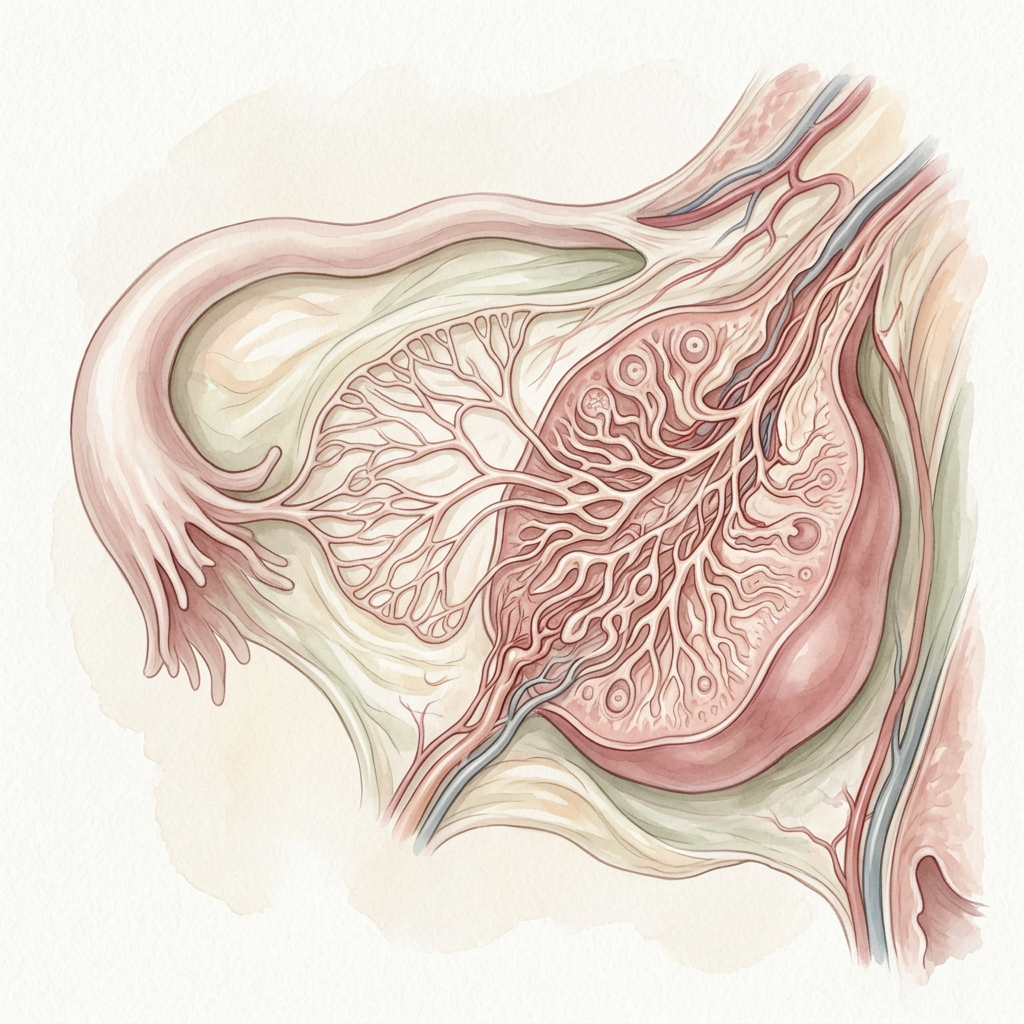
The rete ovarii is a intricate network of cellular cords and fluid-filled tubules located at the hilus (the gateway where blood vessels and nerves enter) of the ovary.
It is the direct female counterpart (homologue) to the male rete testis, a structure in the testicles that helps transport sperm. Because both biological sexes start with the same cellular blueprints in the womb, the rete ovarii forms during early embryonic development in females, mirroring the male structure.
Structurally, it is divided into three distinct zones:
* The Intraovarian Rete: A network of cell cords woven inside the ovary itself.
* The Extraovarian Rete: A winding maze of tubules located just outside the ovary, lined with microscopic, hair-like cilia.
* The Connecting Rete: A bridging pathway that links the inner and outer sections together.
What is its Function?
For over a century, the medical community assumed the rete ovarii did absolutely nothing. However, groundbreaking micro-imaging and protein analysis have revealed that it is highly active:
* Fluid Transport & Nutrient Delivery: The tubules act as a specialized plumbing system. The microscopic cilia beat in unison to pump a protein-rich fluid into the ovary. This fluid carries thousands of distinct proteins that are believed to nurture and support the development of egg cells (oocytes).
* The Hormonal “Antenna”: The rete ovarii is densely populated with nerves and blood vessels. Scientists hypothesize that it acts like a sensory antenna, monitoring the body’s fluctuating hormone levels and adjusting its fluid secretions to match what the ovary needs at any given moment.
* Fertility and Disease Links: By regulating the ovarian environment, it may play a critical role in reproductive health. Furthermore, abnormalities or blockages in these tubules are now being studied as a potential root cause for certain types of ovarian cysts.
Why Was it Erased From Science?
If this organ is so active, how did it vanish from modern medical consciousness?
The erasure of the rete ovarii stems from historical biases and technological limitations:
* The “Male As The Standard” Bias: Early anatomists often viewed female reproductive structures through a male lens. Because the rete testis has a clear, easily observable job (transporting sperm), and the female version did not carry eggs in the same obvious way, 19th-century scientists quickly labeled it a “vestigial remnant” or useless anatomical leftover.
* The Medical Echo Chamber: Once the label of “functionless vestige” was printed in early medical literature, it was copied from textbook to textbook without being questioned. Over the generations, editors looking to save page space simply stopped including it entirely.
* Technological Blindspots: The rete ovarii is incredibly small, fragile, and difficult to see using traditional 2D tissue slicing under standard microscopes. It required modern 3D tissue-clearing imaging technologies and advanced mass spectrometry to finally prove that the organ wasn’t just sitting there, it was actively “talking” to the rest of the reproductive system.
The rediscovery of the rete ovarii is a stark reminder that science is never truly “settled” and that the human body, and our world, are still riddled with overlooked mysteries hiding in plain sight.
get involved and support this work today
If you’ve ever found value in my work, if you’ve ever learned something that could help you or someone you care about, I ask you to consider contributing in one of the following ways:
-> Paid Subscriptions
If you want to access exclusive content, early updates, my book, or deeper dives into my research, consider subscribing to my platform on Substack.
Dr Lidiya Angelova | Substack
-> Get or Gift someone my BOOK → Essential Handbook for Restoring Balance After Vaccination and Everyday Life Challenges – Payhip.
There you will find relief from today’s stress and vaccines adverse reactions. Crafted for anyone feeling overwhelmed. It’s kept short on purpose, helping your brain quickly absorb and retain its wisdom. Print it out or pin it up for easy reference. You won’t need expensive supplements or oddly named teas.
If you’re a paid subscriber to my substack, you’ll receive it at no cost. Download it for free from here.
Looking ahead, I’m creating a healing cookbook and every paid subscriber will get it free.
-> Direct support: If you prefer a one-time contribution over a subscription, direct donations help cover software costs, research materials, and the time I invest in creating and sharing content. You can support directly through PayPal or bank transfer.
Make a one-time donation
Make a monthly donation
Make a yearly donation
Choose an amount
Or enter a custom amount
Your contribution is appreciated.
Your contribution is appreciated.
Your contribution is appreciated.
-> Collaborations & Partnerships: If you run an organization, business, or project that aligns with this mission, let’s work together. Reach out via genuineprospect@proton.me to explore joint initiatives, grants, or partnerships.
This platform exists because readers who value an independent perspective choose to support it. Pick the option that works best for you, and let’s keep building.

Leave a Reply